

The Vent Sizing Package 2 (VSP2) is a robust, highly adaptable adiabatic calorimeter designed to simulate process upset conditions and generate accurate low thermal-inertia data. These experiments primarily yield adiabatic temperature and pressure rise rates, which are directly scalable for emergency relief system design. Beyond vent sizing, the VSP2’s precise pressure measurement capabilities make it an effective tool for investigating vapor-liquid equilibrium in a sealed test cell. The following examples illustrate three types of experiments that can be performed using the VSP2.
Fixed Temperature Gas Absorption Study Using the VSP2
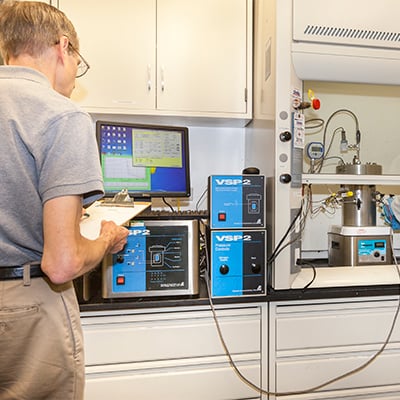 The VSP2 was utilized to study the equilibrium pressure of a system as a liquid absorbed gas at an elevated temperature. The purpose of the experiment was to determine the relationship between the amount of gas absorbed and the equilibrium pressure of the system at 120°C.
The test cell was evacuated before sample was added, and then the headspace was re-evacuated to remove any air introduced with the sample. The absorption of the gas and subsequent reaction was exothermic, therefore the test cell was outfitted with a cooling coil to cool the sample back to 120°C. The gas was added to the liquid sample subsurface using a dip tube and the quantity of gas added was measured with a pressure transducer on the sample cylinder containing the gas. After gas was added, compressed air was passed through the cooling coil to cool the sample to 120°C. Once the pressure stabilized, more gas was added. This process was repeated until the equilibrium pressure reached approximately 3 bar above the vapor pressure of the sample at 120°C. The moles of gas added were calculated using the ideal gas law, accounting for the compressibility factor of the gas. The changing compressibility of the gas was determined using FERST powered by CHEMCAD [1] for each addition. The data for this experiment are shown in Figure 1 and Figure 2.
Figure 1 shows the temperature increasing when gas is added, showing the exothermic nature of the gas absorption. It is important to allow the temperature and pressure to stabilize to properly understand how the equilibrium pressure is changing as gas is absorbed.
Figure 2 shows that the equilibrium pressure at 120°C is increasing as gas is absorbed. It also confirms that during cooldown, the liquid was able to absorb more gas as the cooldown pressure approached the initial vapor pressure of the sample at 25°C.


Fixed Mass Heat-Wait-Search Equilibrium Study Using the VSP2
The VSP2 was utilized to study the equilibrium pressure of a closed liquid/gas system at various temperatures. The purpose of the experiment was to characterize the relationship between the temperature and pressure of the system. A Heat-Wait-Search methodology was chosen to allow more time for the gas and liquid to reach equilibrium.
The test cell was purged and evacuated before the moisture sensitive sample was added, and then the headspace was re-evacuated to remove any introduced nitrogen. The gas was added to the headspace of the test cell, and the amount was quantified using a pressure transducer. The temperature was allowed to stabilize at room temperature, and then a Heat-Wait-Search routine was programmed from 30°C to 100°C with 30-minute holds in 10°C increments. The mass of gas added was calculated using the ideal gas law, accounting for the compressibility of the gas. The compressibility of the gas was determined using data provided by the client.
The data for this experiment are shown in Figure 3 and Figure 4. The data collected during the addition of the gas in the first 50 minutes of the experiment are not shown in Figure 4.

Fixed Mass Constant Ramp Equilibrium Study Using the VSP2
The VSP2 was utilized to study the vapor pressure of liquid sample in a closed system. A constant ramp methodology was used to heat the sample. Multiple thermocouples were used to ensure the sample temperature was uniform throughout.
The test cell was purged and evacuated before the sample was added, and then the headspace was re-evacuated to remove any introduced air. The auxiliary heater was enabled at 30% low power to heat the sample at approximately 1°C/min to 300°C. The data for this test are shown in Figure 5 and Figure 6. The pressure data in Figure 6 were corrected for the initial pad gas in the test cell.

Conclusion
The VSP2 delivers reliable temperature and pressure measurements from sub-ambient to high-temperature and high-pressure conditions for a wide range of chemistries. The scale (~120 ml test cell), strong stirring, and multiple in-sample temperature measurements make the VSP2 a versatile choice for designing such experiments. In addition to supporting emergency vent sizing, such low thermal inertia data are invaluable for characterizing key physical properties of process materials.
References
- FERST powered by CHEMCAD Version 1.0.0.16848, Fauske & Associates, 2021